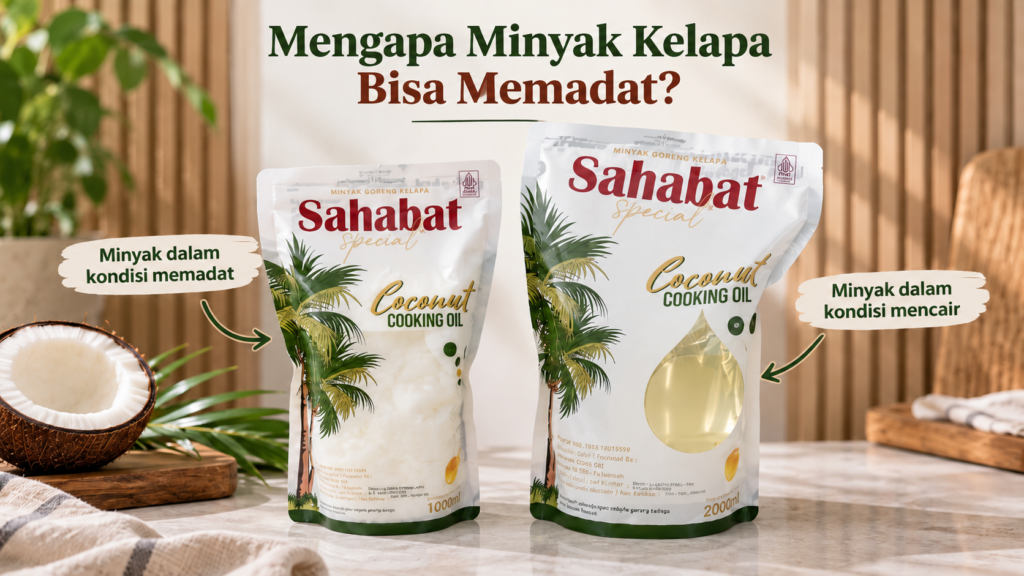
Coconut oil that starts out as a liquid may turn cloudy, develop white clumps, or solidify when stored in a cool place. This often raises a question: is it still safe to use?
Coconut oil solidifies because lower temperatures cause fat crystals to form. Regular coconut oil has a melting point of around 24–26°C (75–79°F), so its consistency can change depending on the storage temperature. Solidification caused by temperature alone is not a sign of spoilage. PMC
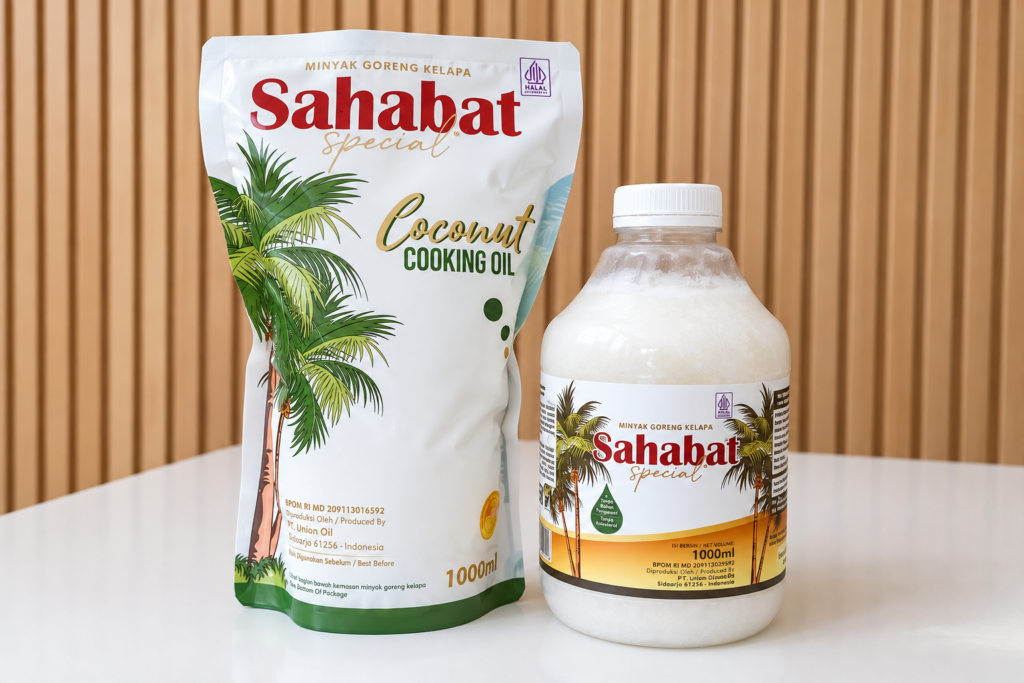
Table of Contents
- Why Does Coconut Oil Solidify in Cold Temperatures?
- At What Temperature Does Coconut Oil Solidify?
- Why Does Coconut Oil Solidify in Air-Conditioned Rooms?
- Are White Clumps in Coconut Oil Normal?
- Can You Still Use Solidified Coconut Oil?
- How to Melt Solidified Coconut Oil
- Can Both VCO and RBDCNO Solidify?
- Does Solidification Prove Coconut Oil Is Pure?
- How to Store Coconut Oil
- Frequently Asked Questions About Solidified Coconut Oil
- Find the Right Coconut Oil for Your Kitchen
Why Does Coconut Oil Solidify in Cold Temperatures?
Coconut oil is a mixture of triglycerides—fat molecules containing different types of fatty acids. It is rich in saturated fatty acids, including lauric acid. This composition affects how the oil behaves when cooled or warmed.
As the temperature drops, some triglycerides begin to form crystals. The oil may then appear cloudy, grainy, partially solid, or completely solid. When the temperature rises, these crystals can melt, turning the oil liquid again.
Source: Oklahoma State University
This is a physical change that can occur naturally. Coconut oil does not need to undergo hydrogenation to become solid.
At What Temperature Does Coconut Oil Solidify?
The melting range of 24–26°C (75–79°F) is a general guide, rather than an exact threshold at which every coconut oil immediately solidifies. Crystal formation depends on the oil’s composition and cooling history. The temperature at which crystallization begins is not necessarily the same as the temperature at which all the crystals finish melting.
Source: PMC
As a general reference, the United States Pharmacopeia’s Food Chemicals Codex describes nonhydrogenated coconut oil as a fairly hard solid at around 21°C (70°F) or below and a liquid at around 27°C (81°F).
| Temperature Conditions | Possible Appearance |
|---|---|
| Cool, around 21°C (70°F) or below | Solid or fairly hard |
| Near the melting range | Cloudy, partially liquid, or partially solid |
| Warm, around 27°C (81°F) | Usually liquid |
This table provides general guidance, rather than specifications for every product. Always follow the storage instructions on the label.
Why Does Coconut Oil Solidify in Air-Conditioned Rooms?
An air-conditioned room can lower the oil’s temperature enough for crystals to form. For example, oil that is liquid in a warm kitchen may become cloudy or solid after spending enough time in a cooler room.
Source: doi.usp.org
What matters is the temperature of the oil itself, rather than just the air conditioner’s temperature setting. Changes in consistency may therefore take time to appear after the container is moved.
Are White Clumps in Coconut Oil Normal?
White clumps may be fat crystals that form as the oil cools. The oil may also appear partially liquid and partially solid. NOW Foods explains that white clumps and transitions between liquid and solid forms are natural characteristics of coconut oil.
Source: NOW Foods
However, do not assume that every unfamiliar particle is a fat crystal. If the appearance seems unusual, check the packaging, smell, expiration date, and any possibility of contamination. Contact the manufacturer if you are unsure.
Can You Still Use Solidified Coconut Oil?
Coconut oil that solidifies because of cooler temperatures can generally still be used, provided the product remains suitable for use and has been stored as instructed. A change in consistency alone does not indicate a loss of quality.
Source: NOW Foods
Distinguish temperature-related changes from signs such as a rancid smell or an appearance that differs from the product’s normal characteristics. Do not use oil that shows suspicious changes or has passed the expiration date on its label. Melting spoiled oil does not restore its quality.
Source: LouAna Coconut Oil
How to Melt Solidified Coconut Oil
Use gentle heat. If the packaging is suitable, placing the container in warm water can help melt the oil. Alternatively, scoop out the amount you need and warm it slowly in a pan over low heat.
Follow these steps:
- Check the packaging instructions before warming the container.
- If using a warm-water bath, keep the lid closed and the water level below the lid.
- Wait until the oil is liquid enough to pour.
- Dry the outside of the container before opening it.
Do not place a bottle or pouch directly over a flame. If the packaging is unsuitable for heating, transfer the oil to a heat-resistant container. Do not add water to the oil to melt it.
Can Both VCO and RBDCNO Solidify?
Yes. Both virgin coconut oil (VCO) and refined coconut oil (RBDCNO) can transition between liquid and solid forms. This characteristic is not exclusive to VCO.
Source: NOW Foods
Their production processes differ, but refined coconut oil retains the melting characteristics of coconut fat. A solid consistency alone is therefore not enough to distinguish VCO from RBDCNO.
To learn more about these products, read:
- What Is Virgin Coconut Oil (VCO)?
- What Is RBDCNO?
Does Solidification Prove Coconut Oil Is Pure?
Solidification alone does not prove that coconut oil is pure. The oil’s physical form is not enough to confirm its entire composition.
Some coconut oil products are also specially processed to remain liquid at room temperature. NOW Foods, for example, describes this characteristic in its liquid coconut cooking oil.
Source: NOW Foods
Check the ingredient list, manufacturer details, and product information. For purchasing or quality control, use appropriate technical specifications and test results.
How to Store Coconut Oil
Coconut oil can be stored in either liquid or solid form. Refined coconut oil generally does not require refrigeration. Keep it away from direct sunlight and excessive heat, and prioritize the storage instructions on the product label.
Source: LouAna Oils
Always close the container after use and use clean, dry utensils to scoop out the oil.
Frequently Asked Questions About Solidified Coconut Oil
Why does coconut oil turn white when cold?
Fat crystals that form during cooling can make the oil look white or cloudy.
Source: NOW Foods
Does solidified coconut oil mean it has spoiled?
No. If cooler temperatures cause it to solidify, the change is normal. Whether the oil is still suitable for use depends on its condition and the instructions on its label.
Source: NOW Foods
Can coconut oil become liquid again?
Yes. Gentle warming can melt the fat crystals and return the oil to its liquid form.
Source: LouAna Oils
Why does coconut oil clump when mixed with cold ingredients?
Cold ingredients can lower the oil’s temperature, causing temporary clumps to form. Where the recipe allows, use ingredients close to room temperature to help them mix more easily.
Source: LouAna Oils
Find the Right Coconut Oil for Your Kitchen
Understanding how temperature affects coconut oil helps you handle it properly. To explore product options and usage instructions, visit Sahabat Coconut Oil.
Masak Lebih Sehat dengan Minyak Goreng Kelapa Sahabat
100% minyak kelapa murni untuk rumah tangga, usaha, dan industri. Belanja online atau hubungi tim kami.