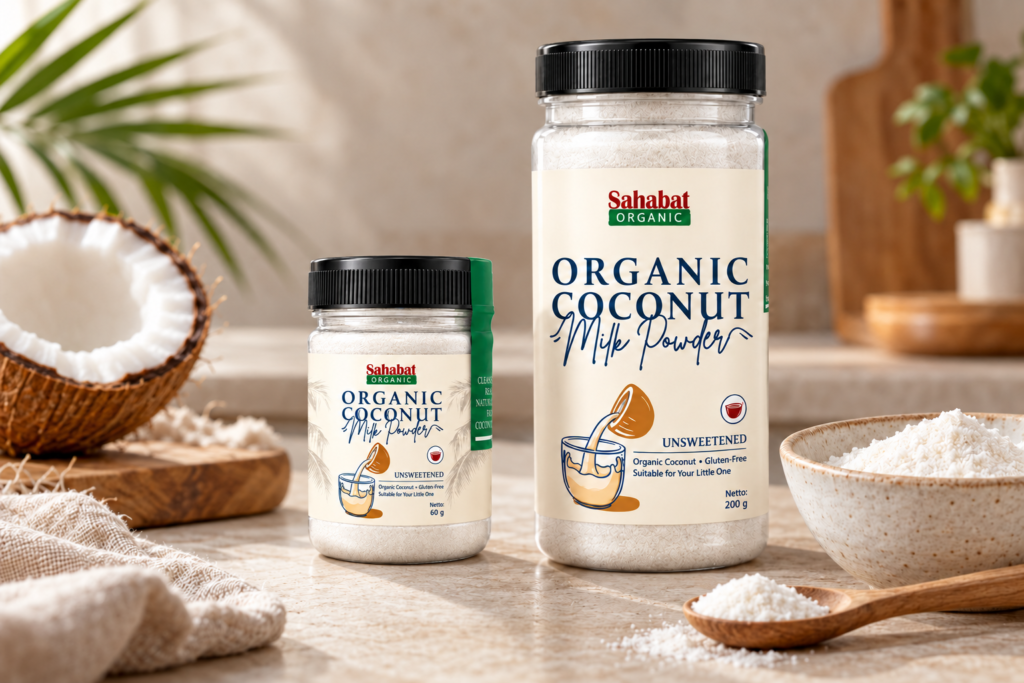
Coconut milk powder is a dried form of coconut milk, commonly produced through spray drying. It can be mixed with water to prepare liquid coconut milk or used in recipes designed for the powder. It brings coconut flavor to dishes such as curries, sauces, desserts, and baked goods. [1]
In Indonesia, it is commonly known as santan bubuk. Before using it, check three things: the ingredient list, the mixing instructions, and the storage directions. Products can differ in composition, so the same amount of powder does not necessarily produce the same result across brands.
Table of Contents
How Is Coconut Milk Powder Made?
Manufacturers process liquid coconut milk into a dry ingredient. Renuka, for example, describes pasteurizing coconut milk and then spray drying it to produce a fine powder. [1]
The process differs from simply grinding dried coconut flesh. Powdered coconut milk is intended to provide the flavor and body of coconut milk, whereas grated dried coconut contributes noticeable coconut pieces.
Commercial formulas may also include ingredients other than coconut. These vary by manufacturer and application, so a product name alone does not tell you its full composition.
What Ingredients Does It Contain?
The base is coconut milk or coconut extract, but some formulations contain additional ingredients. Nutra Food Ingredients lists coconut milk and maltodextrin, with sodium caseinate included or omitted depending on the formulation. [2]
Here are examples of ingredients you may encounter:
| Ingredient on the label | What to check |
|---|---|
| Coconut milk or coconut extract | Whether a percentage or detailed specification is provided |
| Maltodextrin | Whether it appears in the formula; do not assume the powder contains coconut alone |
| Sodium caseinate or milk protein | Whether the product contains dairy ingredients |
| Stabilizers or acidity regulators | Which ingredients are listed for that particular product |
For example, Nestlé Professional Australia lists coconut milk powder, maltodextrin, milk protein, and a sodium phosphate stabilizer in one of its products. This is an example of a specific formula, not a description of all coconut milk powders. [3]
Is Coconut Milk Powder Dairy-Free or Vegan?
Not automatically. Some products contain sodium caseinate, a milk-derived protein. A coconut-based name does not guarantee a dairy-free or vegan formula. [4]
Check the complete ingredient list, allergen declaration, and relevant product claims. If your menu requires a vegan ingredient, confirm the exact product’s suitability rather than applying a category-wide assumption.
For Sahabat products, use the current packaging or request the latest product information before making dietary claims.
Coconut Milk Powder vs. Other Coconut Ingredients
Several coconut ingredients can look similar while doing different jobs in a recipe.
| Ingredient | Form and main role | Practical selection tip |
|---|---|---|
| Coconut milk powder | Powder used to prepare coconut milk or incorporated into suitable recipes | Follow the product’s mixing instructions |
| Liquid coconut milk | Coconut milk supplied in liquid form | Check its richness and the recipe’s requirements |
| Desiccated coconut | Dried coconut flesh in small pieces or shreds | Choose it when the recipe needs coconut texture |
| Coconut flour | A flour ingredient used in formulated batters and doughs | Do not treat it as an instant coconut milk mix |
These products should not be swapped simply because they all contain coconut. First identify whether the recipe needs a liquid, a flour, or pieces of coconut.
How to Use Coconut Milk Powder
Suppliers identify applications ranging from sauces and beverages to bakery and confectionery products. [1] The best starting point is a recipe that specifies either coconut milk or the powder itself.
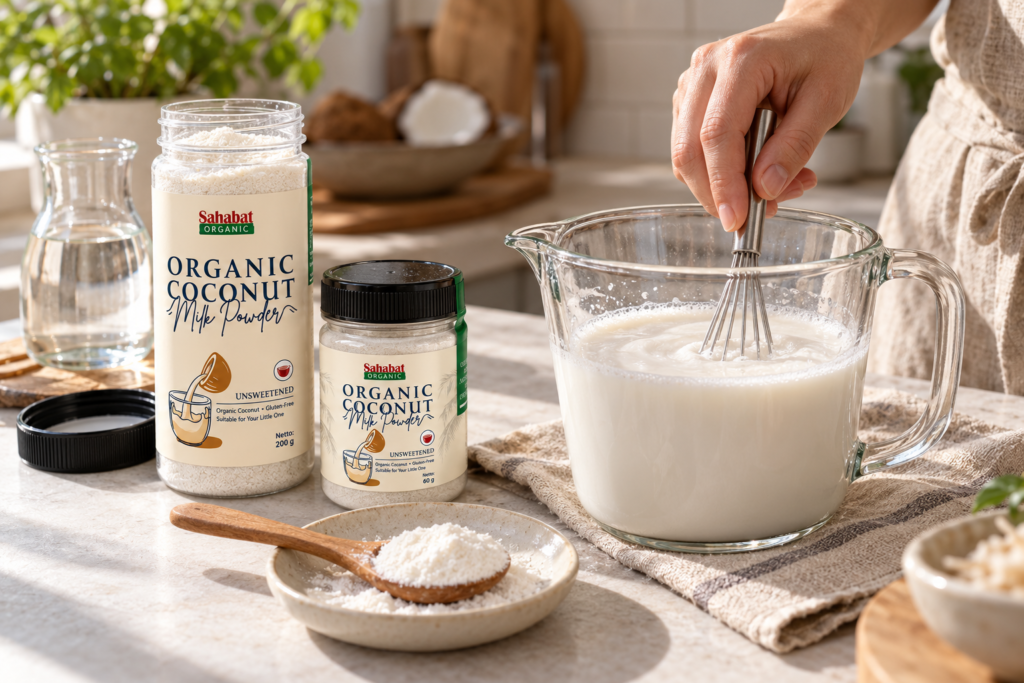
Curries, Soups, and Sauces
For recipes calling for liquid coconut milk, prepare the powder according to its label before measuring the required amount.
For a first trial, keep the rest of the recipe unchanged. Assess the finished sauce, then record any adjustment you want to make next time. Changing the brand, dilution, and recipe quantities all at once makes it harder to identify what affected the result.
Cakes and Other Baked Goods
If a cake recipe calls for liquid coconut milk, use prepared coconut milk in the stated quantity. Do not replace a measured volume of liquid with the same volume of dry powder.
Adding the powder directly is a separate approach. Choose a recipe that accounts for it, or test a small batch when developing your own formula.
Drinks and Desserts
Powdered coconut milk can be explored in coconut-flavored drinks, puddings, and frozen desserts. Start with the intended recipe and the product’s preparation guidance.
For café development, compare small samples and record the powder weight, water quantity, and other ingredients. This gives staff a repeatable method instead of relying on an unmeasured scoop.
Dry Recipe Mixes
Where the product is suitable for dry applications, it may be incorporated into a formulated mix. [1] For commercial use, ask the supplier for application guidance and test the finished recipe before changing production.
How to Mix It with Water
Use the ratio printed on your own package. There is no single mixing ratio that should be applied to every brand.
Some manufacturers recommend warm water and provide different quantities for milk-like and cream-like preparations. Nestlé Professional Australia is one example. [3] Those directions apply to that product and should not be treated as Sahabat’s instructions.
A practical workflow is:
- Read the package directions, including the water temperature and intended use.
- Measure the powder and water separately.
- Combine them gradually while stirring or whisking.
- Check for dry pockets before measuring the prepared mixture into your recipe.
- Record the quantities if you plan to repeat the dish.
If the package gives a final yield, use that information. Do not assume the final volume equals the starting volume of water.
How to Store Coconut Milk Powder
Dry powder and coconut milk prepared with water need different handling.
Before Opening
Follow the manufacturer’s storage conditions and date marking. Keep the packaging intact and store it in the recommended environment. Renuka, for example, specifies a clean, dry storage location for its powder. [1]
Choose a cupboard away from cooking steam and sources of heat if that is consistent with the label.
After Opening
Close the pack securely or transfer the contents to a clean, dry, airtight food container. Use a dry spoon; Nestlé Professional Australia explicitly includes these instructions for its product. [3]
As a practical kitchen habit, write the opening date on the container and retain the original label. This keeps the ingredients, batch details, and storage directions available.
After Mixing with Water
Do not apply the unopened powder’s shelf life to prepared coconut milk. Follow any separate instructions for the reconstituted product and refrigerate unused prepared milk promptly rather than leaving it on the counter.
If no holding time is specified, prepare only the amount needed for the recipe and ask the manufacturer for guidance on leftovers. This article does not assign a universal number of storage days.
How to Choose a Product for Your Kitchen
Compare products using details that matter to your recipes:
- Ingredients and dietary requirements: Read the complete label.
- Preparation instructions: Look for clear quantities and intended consistency.
- Recipe performance: Test the same dish before changing brands.
- Pack size: Choose an amount that fits your rate of use.
- Storage guidance: Check both unopened and after-opening directions.
- Supplier information: For business orders, request current specifications and application guidance.
For a fair kitchen comparison, follow each product’s instructions and compare the prepared results. Equal scoops of different powders may not represent equivalent preparations.
Frequently Asked Questions
What is coconut milk powder used for?
It is used to prepare coconut milk and in suitable recipes for sauces, curries, baked goods, drinks, and desserts. Follow the product label and the recipe’s preparation method.
Is it the same as desiccated coconut?
No. Desiccated coconut is dried coconut flesh in pieces or shreds. Powdered coconut milk is a different ingredient used to provide coconut milk in recipes.
Does it contain dairy?
Some formulas do. Check for milk protein or sodium caseinate and read the allergen declaration. Do not assume every coconut-based powder is dairy-free.
Can it replace canned coconut milk?
It can be considered when prepared to suit the recipe, but richness and composition may differ. Use the manufacturer’s directions and test the result rather than swapping dry powder directly for liquid.
Should it be stored in the refrigerator?
For the dry powder, follow the package directions. Once mixed with water, treat it as a prepared perishable ingredient and follow the manufacturer’s refrigerated-storage guidance.
How long does it last after opening?
There is no universal answer. Use the specific product’s after-opening instructions; its unopened shelf life does not automatically apply after opening or mixing.
Explore Coconut Ingredients with Sahabat
Choosing the right coconut ingredient starts with understanding its role in your recipe. Check the label, follow the mixing directions, and keep a record of combinations that work in your kitchen.
Explore the coconut product range at Sahabat Coconut Oil. For home cooking or business use, contact the team for current product details, preparation guidance, and available pack sizes.
Sources
- Renuka — Coconut Milk Powder: production method, applications, and product-specific storage.
- Nutra Food Ingredients — Coconut Milk Powder: examples of formulation differences.
- Nestlé Professional Australia — MAGGI Coconut Milk Powder: ingredient example, preparation, and opened-pack handling.
- Nestlé Professional UAE — MAGGI Coconut Milk Powder: sodium caseinate identified as a milk ingredient.
Supplier examples describe those suppliers’ products. They do not establish the ingredients, mixing ratios, or shelf life of Sahabat products.
Masak Lebih Sehat dengan Minyak Goreng Kelapa Sahabat
100% minyak kelapa murni untuk rumah tangga, usaha, dan industri. Belanja online atau hubungi tim kami.