To measure coconut oil for baking, follow the recipe’s specified weight and consistency. If it lists grams, weigh the oil, then prepare it in the required state—solid, softened, or melted. If it lists cups or tablespoons, check whether the oil should be measured before or after melting.
This distinction matters because measuring the correct amount and using the correct texture are two separate steps. You can weigh the right quantity but still affect the recipe by adding melted oil when it calls for softened fat.
Here is a practical guide to getting both steps right.
Table of Contents
How to Measure Coconut Oil: A Quick Guide
| What the recipe says | How to measure it | Before adding it |
|---|---|---|
| “100 g coconut oil, melted” | Weigh 100 g, then melt | Let it cool if instructed, while keeping it liquid |
| “½ cup melted coconut oil” | Melt first, then measure the liquid | Check that no solid pieces remain |
| “½ cup coconut oil, melted” | Conventionally, measure first, then melt | Follow any additional recipe notes |
| “½ cup solid coconut oil” | Press into a dry measuring cup, remove gaps, and level | Keep it in the specified solid state |
| “Softened coconut oil” | Use the listed weight or volume | It should be workable rather than fully liquid |
Recipe wording is not always consistent. When an ingredient list is unclear, check the method and the author’s notes before deciding how to measure it.
Why Coconut Oil’s Consistency Matters
Ordinary coconut oil can become firm in cooler conditions and liquid in a warm kitchen. Around its melting range, a container may hold a mixture of clear liquid and white solid pieces. These temperature-related changes are normal. www.nowfoods.com
For baking, that means “room temperature” does not always describe the same consistency. Oil sitting on a warm Indonesian kitchen counter may be fully liquid, while the same product in an air-conditioned room may be firm.
Look at the texture the recipe requires instead of relying only on how long the oil has been sitting outside.
For more background, read why coconut oil can solidify.
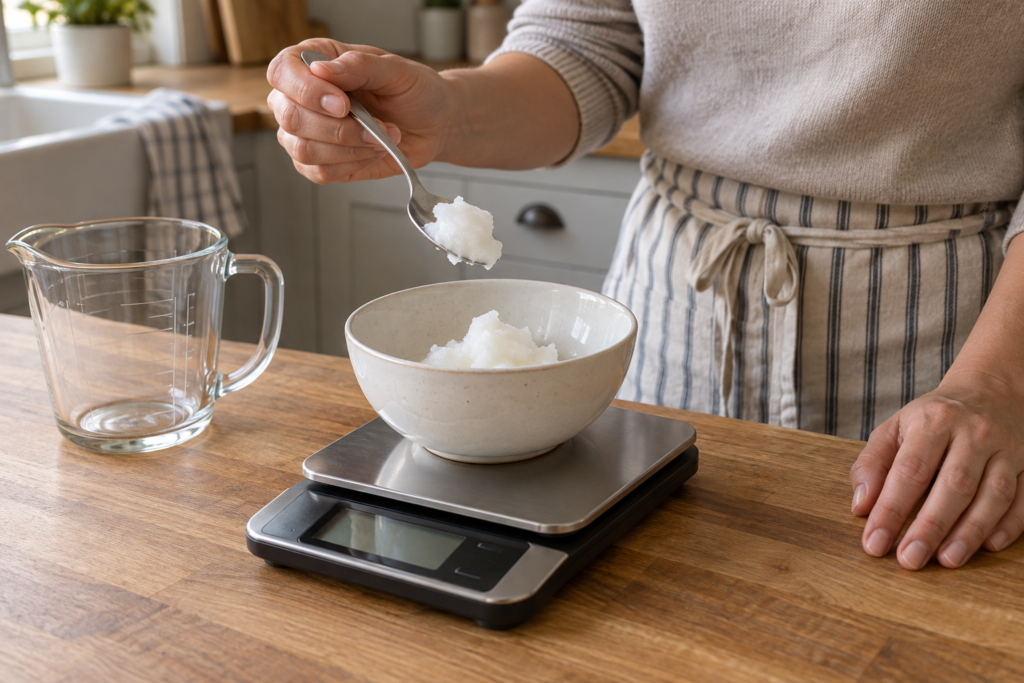
1. Use a Kitchen Scale When the Recipe Provides Grams
A scale avoids the difficulty of packing solid oil into a cup or reading a small volume of liquid.
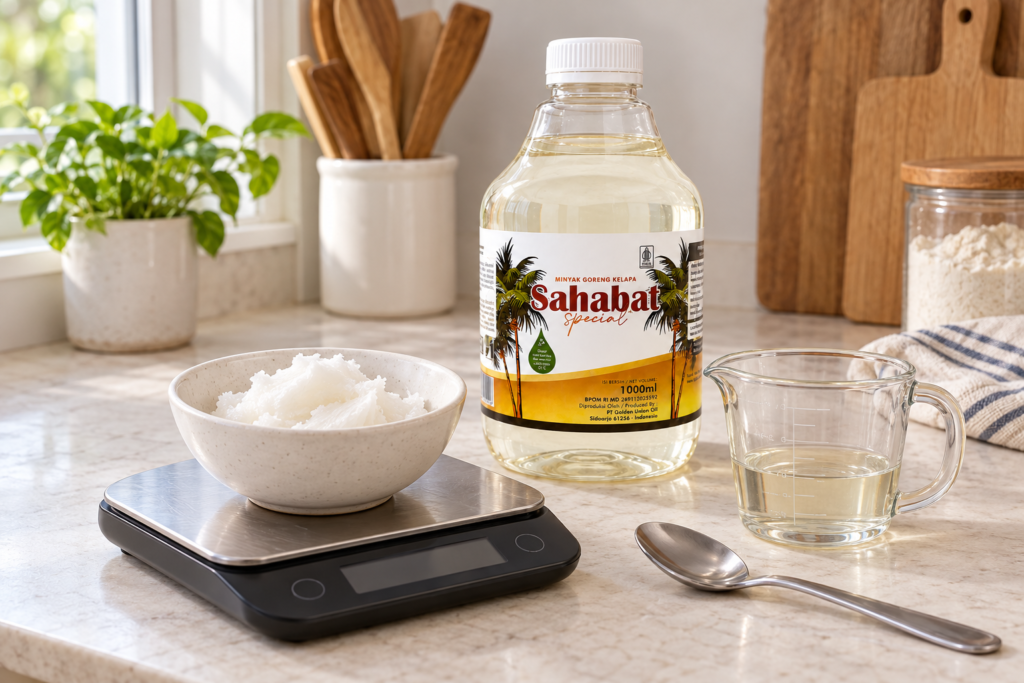
To weigh coconut oil:
- Place a clean, dry bowl on the scale.
- Press tare or zero.
- Add coconut oil until you reach the weight stated in the recipe.
- Prepare the oil in the required consistency.
- Transfer it thoroughly into the mixture, using a spatula if needed.
Melting does not change the amount of oil you weighed, provided none is spilled or left behind. A 100 g portion remains approximately 100 g after melting.
However, weighing does not remove the need to follow temperature instructions. If the recipe calls for solid oil, a correctly weighed liquid portion is still in the wrong state.
King Arthur Baking’s recipe guidance supports measuring by weight and advises using the ingredient weight supplied in the particular recipe when it differs from a general conversion chart. King Arthur Baking
2. How to Measure Melted Coconut Oil by Volume
When a recipe specifies melted coconut oil in cups or milliliters, measure it once it is fully liquid.
Follow these steps:
- Transfer some coconut oil into a clean, dry, heat-safe container.
- Warm it gently until the solid pieces have melted.
- Pour it into a liquid measuring cup.
- Set the cup on a level surface.
- Check the measurement at eye level.
- Add or remove a little oil to reach the required amount.
For small quantities, use a proper measuring spoon. Fill it level rather than estimating with an ordinary eating spoon.
Avoid measuring a mixture of liquid oil and loosely packed solid chunks. It is harder to judge the volume accurately, particularly when gaps remain between the pieces.
3. How to Measure Solid Coconut Oil by Volume
If the recipe explicitly requires solid coconut oil, use a dry measuring cup or measuring spoon.
Spoon the oil into the measure in small portions. Press it gently into the corners to reduce air pockets, then level the top with a straight edge.
Do not heap the oil above the rim. A rounded scoop can contain more than the recipe intends.
If the oil is too hard to handle, allow it to soften just enough to scoop. Keep an eye on its consistency so it does not become fully liquid when the recipe requires a solid fat.
For repeated batches, a recipe with tested gram measurements will be easier to standardize than one that depends on how firmly each person packs a cup.
4. Read “Melted” and “Softened” as Different Instructions
Softened coconut oil should be workable but still hold some shape. Melted coconut oil flows as a liquid.
These states affect how the fat combines with other ingredients. A method that asks you to beat softened fat with sugar is different from one that asks you to whisk liquid oil into wet ingredients.
King Arthur Baking’s tests with alternative fats showed that substitutions can change baking results and highlighted the challenges of coconut oil in recipes requiring chilled or solid fat. Those findings reinforce the need to follow the particular recipe rather than assume every form works the same way. www.kingarthurbaking.com
If you accidentally melt oil intended for a softened-fat method, let it return to the required consistency before proceeding.
5. Check Ingredient Temperatures Before Mixing
Melted coconut oil can start to firm up when it meets very cold ingredients. You may notice small white pieces appearing as you mix.
To reduce this problem:
- Read the recipe’s temperature instructions before starting.
- Prepare the other ingredients before melting the oil.
- Let melted oil cool as instructed without allowing it to solidify.
- Avoid adding very hot oil directly to eggs or batter.
- Mix in the sequence specified by the recipe.
Do not heat the entire batter aggressively to dissolve oil lumps. That can affect other ingredients. Preventing a large temperature difference is usually easier than correcting the mixture afterward.
How Many Grams Are in a Cup of Coconut Oil?
There is no need to guess when the recipe provides its own gram amount.
As one published reference, King Arthur Baking lists ½ cup of coconut oil as 113 g. This is a working baking conversion from that source, not a universal measurement for every cup size and measuring method. King Arthur Baking
Cup standards and preparation methods can differ between recipes. Use the author’s weight where available, and avoid switching between conversion charts during the same recipe.
Also, do not assume that 100 ml of coconut oil equals 100 g. Milliliters measure volume; grams measure mass.
Common Measuring Mistakes to Avoid
| Mistake | Better approach |
|---|---|
| Scooping solid oil loosely into a cup | Fill gaps and level the surface |
| Using a household spoon as a tablespoon | Use a standardized measuring spoon |
| Measuring partially melted oil with solid chunks | Prepare the consistency specified in the recipe |
| Assuming “softened” means liquid | Check whether the oil should still hold its shape |
| Ignoring oil left in the measuring container | Transfer it thoroughly with a spatula |
| Changing measuring methods between batches | Keep the method consistent and record it |
| Assuming correct weight guarantees identical results | Control the oil’s consistency and mixing conditions too |
Choosing Coconut Oil for Your Baking Recipe
Measurement controls the amount of fat. The type of coconut oil also influences flavor.
Virgin coconut oil generally retains more coconut aroma, while refined and deodorized coconut oil is usually milder. extension.okstate.edu
For coconut-forward recipes, consider testing VCO. For recipes where vanilla, chocolate, or other ingredients should lead the flavor, a refined option may be more suitable.
Learn more about virgin coconut oil and refined coconut oil before selecting your ingredient.
Frequently Asked Questions
Should I measure coconut oil before or after melting?
Follow the recipe. “Melted coconut oil” generally means measuring it after melting, while “coconut oil, melted” conventionally means measuring first. If a gram weight is provided, weigh that amount and then prepare the required consistency.
Does solid coconut oil weigh the same after melting?
Yes, provided no oil is lost during heating or transfer. Melting changes its physical state, not the quantity you weighed.
Can I use liquid coconut oil when a recipe asks for solid coconut oil?
Do not assume it will give the same result. Let the oil reach the specified consistency or choose a recipe designed for liquid oil.
Why does my coconut oil form small lumps in the batter?
It may be cooling and beginning to solidify, especially when mixed with cold ingredients. Check the recipe’s temperature instructions before preparing the next batch.
Is a scale better than measuring cups for coconut oil?
A scale is a practical choice when the recipe supplies grams. It avoids air gaps in solid oil and makes repeated portions easier to measure consistently.
Find Coconut Oil for Your Home Kitchen or Bakery
Choosing coconut oil for cakes, cookies, or bakery production? Contact Sahabat to discuss product options, packaging sizes, specifications, and pricing.
Tell us what you bake, your preferred flavor profile, and your estimated usage so we can help you review the available options.
Chat with Sahabat on WhatsApp →
Masak Lebih Sehat dengan Minyak Goreng Kelapa Sahabat
100% minyak kelapa murni untuk rumah tangga, usaha, dan industri. Belanja online atau hubungi tim kami.