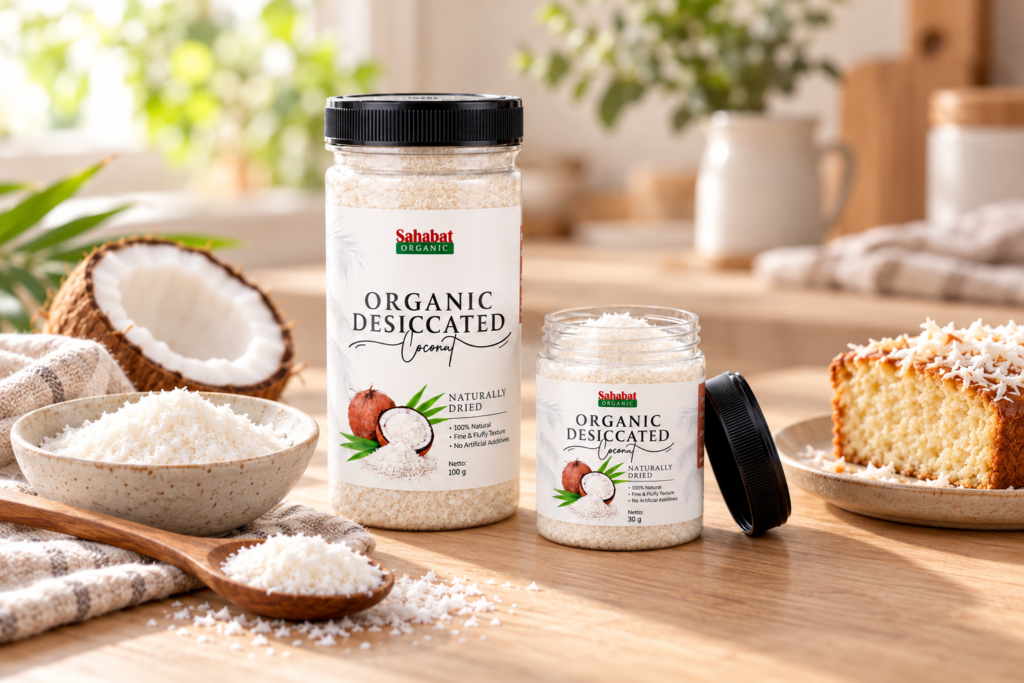
Fine and medium desiccated coconut differ mainly in particle size. Fine grade has smaller particles and is a useful starting point when you want coconut distributed throughout a mixture. Medium grade has larger particles and is worth testing when visible coconut and a more noticeable bite are part of the product.
Neither grade is automatically better. The right choice depends on your recipe, desired appearance, and production requirements.
Table of Contents
What Are Desiccated Coconut Grades?
Desiccated coconut is dried coconut flesh processed into particles or cuts for food applications. Suppliers offer grades such as fine, medium, and other cuts for bakery, confectionery, cereal, and snack production. [1]
In this context, “grade” describes particle size. It does not, on its own, establish fat content, moisture, organic certification, or overall quality.
For buyers, the name on the quotation is only a starting point. Ask for the written particle-size specification and a representative sample before approving a product.
Fine vs. Medium Desiccated Coconut at a Glance
The following comparison offers practical starting points for recipe development. Finished results should be confirmed in your own formulation.
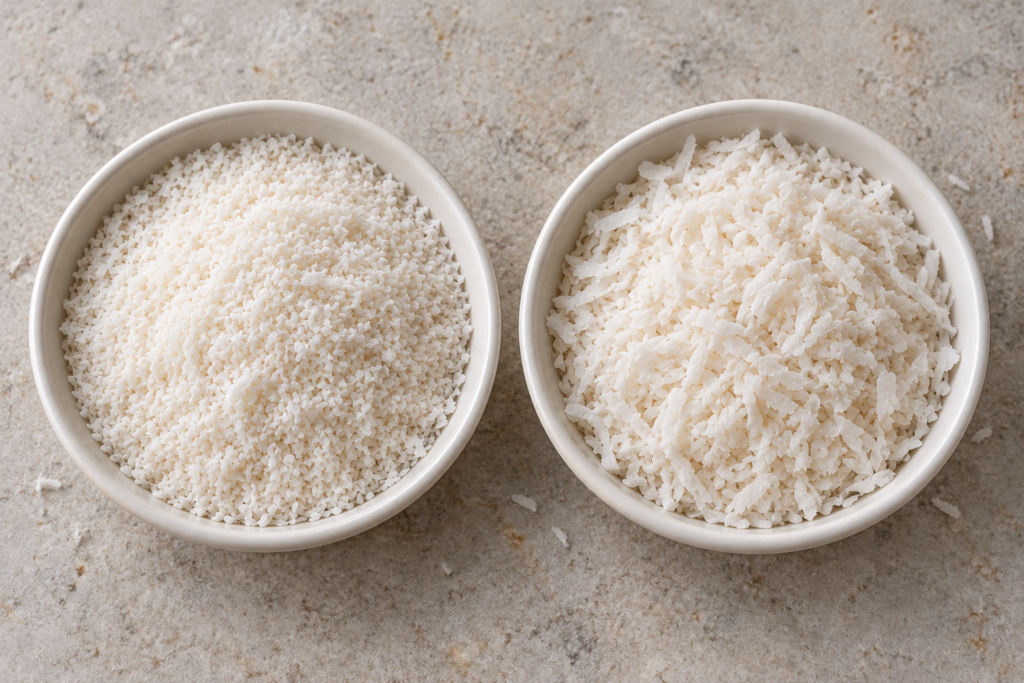
| Comparison | Fine grade | Medium grade |
|---|---|---|
| Particle size | Smaller particles | Larger particles |
| Visual effect | Less prominent individual pieces | More visible coconut particles |
| Texture to evaluate | A finer, more integrated coconut texture | A more distinct coconut bite |
| Potential applications | Cake mixtures, fillings, fine coatings, and small confectionery pieces | Textured cookies, coconut bars, macaroons, and toppings |
| Main trial question | Does it distribute as intended without making the product too dense or dry? | Are the pieces the right size for the desired bite and appearance? |
| Purchasing requirement | Written sieve specification and sample | Written sieve specification and sample |
oth grades can be used across several of these applications. For example, a macaroon can be developed with fine or medium coconut depending on the texture you want.
What Is Fine Desiccated Coconut?
Fine desiccated coconut consists of small dried coconut particles. Consider it when larger coconut pieces would interfere with the appearance or texture you are trying to achieve.
Possible applications to test include:
- Cake and muffin mixtures where you want smaller coconut pieces.
- Coconut fillings for pastries or confectionery.
- Coatings for bite-sized sweets.
- Cookies designed around a finer coconut texture.
Fine grade still has a particulate texture; it does not dissolve into a completely smooth filling. If smoothness is essential, evaluate a sample in the actual filling before selecting it.
Also, do not treat “fine desiccated coconut” as an instruction to replace flour. Keep the coconut ingredient and flour quantities specified by your recipe unless you are deliberately reformulating it.
What Is Medium Desiccated Coconut?
Medium desiccated coconut has larger particles than fine grade. Consider it when visible coconut pieces are part of the product’s appeal.
Potential trial applications include coconut bars, textured cookies, macaroons, snack mixtures, and decorative coatings.
The larger particles give you a different visual starting point, but they do not guarantee a crunchy finished product. Evaluate the result after mixing, baking, cooling, and storage. A moist filling and a dry topping may produce very different eating experiences from the same ingredient.
For toppings, also check how well the coconut adheres and whether the finished product sheds particles during packing or handling.
Do Fine and Medium Have Fixed Particle Sizes?
Do not interpret either grade as a single particle dimension.
Specifications commonly describe a distribution: the percentage of material that passes through, or remains on, particular sieves. For example, one manufacturer lists a minimum of 80% passing through a 1.40 mm sieve for fine grade and a minimum of 90% passing through a 2.80 mm sieve for medium grade. These are supplier-published sizing criteria, not a claim that every particle measures exactly 1.40 mm or 2.80 mm. [1]
Another published product specification uses several sieve sizes and separate retained-percentage ranges for fine and medium products. [2]
When comparing offers, request:
- Sieve aperture sizes in millimeters.
- The percentage passing through or retained at each size.
- The test method or standard used.
- An explanation of whether figures are limits or typical results.
If a supplier quotes only a mesh number, ask which sieve standard it refers to. Compare the full specifications rather than assuming identical grade names guarantee identical material.
Is Fine Grade Lower in Fat Than Medium Grade?
The grade name alone does not tell you the fat content.
A published specification covering both fine and medium coconut, for example, lists the same total-fat range for the two grades. It also specifies moisture separately from particle size. [2]
For a fair comparison, check the product’s fat and moisture specifications alongside its cut. If you compare fine coconut from one supplier with medium coconut from another, several properties may change at once.
Ask whether the product is full-fat or reduced-fat, and confirm the declared fat range. Do not infer this from how fine or coarse it looks.
Can You Substitute Fine for Medium Desiccated Coconut?
You can test a substitution, but identical results should not be assumed.
A practical first trial is to use the same weight of the replacement grade while keeping the rest of the recipe unchanged. This helps isolate the effect of the ingredient change. It is a testing approach, not a universal substitution rule.
Compare:
- How the mixture handles during preparation.
- Whether the coconut is evenly distributed.
- Portioning and shaping consistency.
- Appearance and texture after cooling.
- Coating coverage and loose particles, where relevant.
- Product quality after your normal storage period.
If adjustments are needed, change one variable at a time and document the result. Avoid making several liquid, mixing-time, and baking changes together before you understand the initial difference.
How to Choose a Grade for Bakery Production
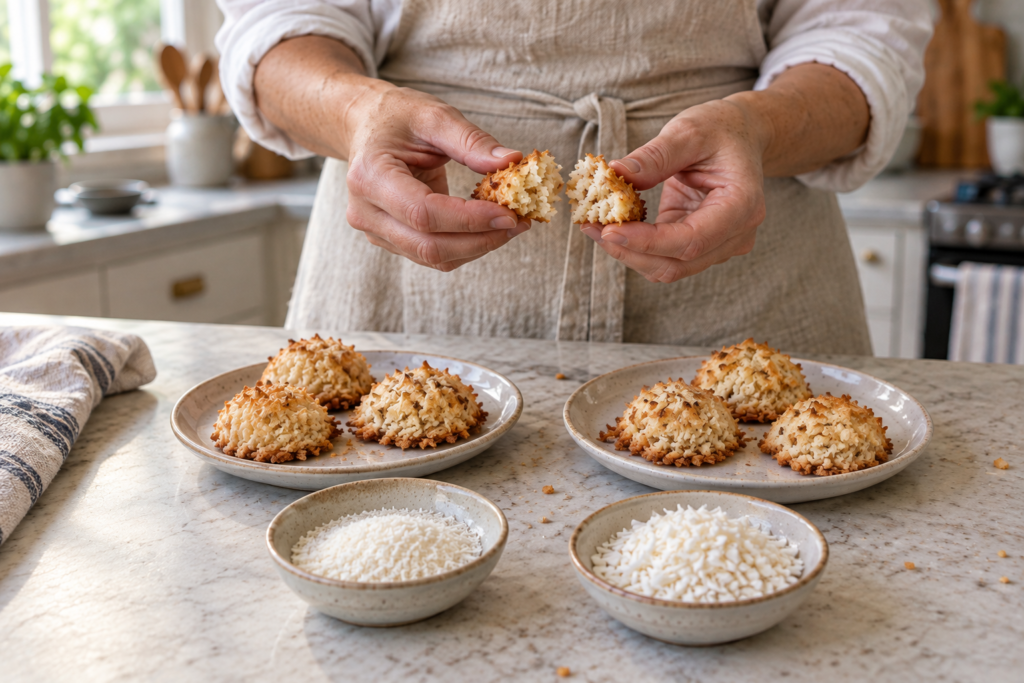
Start with a description of the finished product rather than choosing a grade solely from a price list.
For example, “a small coconut confection with an even coating” gives your supplier a clearer brief than “premium coconut.” Likewise, “a coconut bar with visible pieces and a distinct bite” helps explain why you are considering medium grade.
Run a controlled comparison:
- Obtain representative fine and medium samples.
- Check whether their fat, moisture, and ingredient specifications are comparable.
- Prepare small batches using measured ingredient weights.
- Keep the process consistent between batches.
- Assess finished products at the normal serving temperature.
- Record the preferred sample, supplier, grade, and specification.
For commercial production, repeat the chosen formulation at a suitable trial scale before changing routine purchasing.
What Else Should Buyers Check?
Particle size is one part of an ingredient specification. Before placing a commercial order, request information relevant to your application:
| Item to check | Why it matters |
|---|---|
| Ingredients and any additives | Confirms what will enter your formulation and label review |
| Fat and moisture specifications | Helps distinguish particle-size changes from compositional changes |
| Food-safety documentation and microbiological specifications | Supports supplier approval for the intended use |
| Packaging and net weight | Helps plan storage, handling, and production quantities |
| Lot identification and available batch documentation | Supports traceability |
| Storage instructions and shelf life | Establishes supplier-approved handling conditions |
| Certification scope, if required | Confirms coverage of the specific product being purchased |
Follow the supplier’s storage instructions and reseal opened packs to protect the ingredient from moisture and contamination. Do not transfer a shelf-life claim from one supplier’s product to another.
Discuss Your Desiccated Coconut Requirements with Sahabat
Choosing desiccated coconut starts with the result you want to create. Share your application, preferred texture, packaging needs, and expected quantity with the Sahabat team.
Ask which grades are currently available and request the relevant product specifications. For bakery or confectionery production, discuss sample availability so you can evaluate the ingredient in your own recipe.
Contact Sahabat Coconut Oil to discuss your desiccated coconut requirements.
Frequently Asked Questions
What is the main difference between fine and medium desiccated coconut?
The main difference is particle size. Fine grade contains smaller particles, while medium grade has larger particles that can create more visible coconut texture.
Is fine desiccated coconut better for cakes?
Fine grade is a useful starting point when you want smaller coconut pieces throughout a cake. The best choice still depends on the recipe and the texture you want.
Which grade should I use for coconut macaroons?
Either may work in a recipe developed for it. Test fine for a finer texture and medium for more noticeable coconut pieces, then assess binding, shaping, and the finished bite.
Does medium desiccated coconut contain more fat?
Not necessarily. Particle size and fat content are separate specifications. Check the supplier’s data rather than relying on the grade name.
Are medium desiccated coconut and coconut flakes the same?
Do not assume they are. Suppliers can distinguish medium particles from larger flakes, shreds, and specialty cuts. Request a sample or cut description when appearance matters.
Can I choose a grade from a photo?
A photo can help illustrate appearance, but it cannot confirm particle-size distribution, fat content, moisture, or other quality requirements. Use a specification sheet and representative sample for purchasing decisions.
Sources
- Davidsun Coconuts — Desiccated Coconut: Product Overview and Granulometry Specifications.
- Nuts in Bulk — Desiccated Coconut Fine & Medium Product Specification, document dated February 2, 2021. Used as an example of specification structure, not as a current offer or a specification for Sahabat products.
Masak Lebih Sehat dengan Minyak Goreng Kelapa Sahabat
100% minyak kelapa murni untuk rumah tangga, usaha, dan industri. Belanja online atau hubungi tim kami.